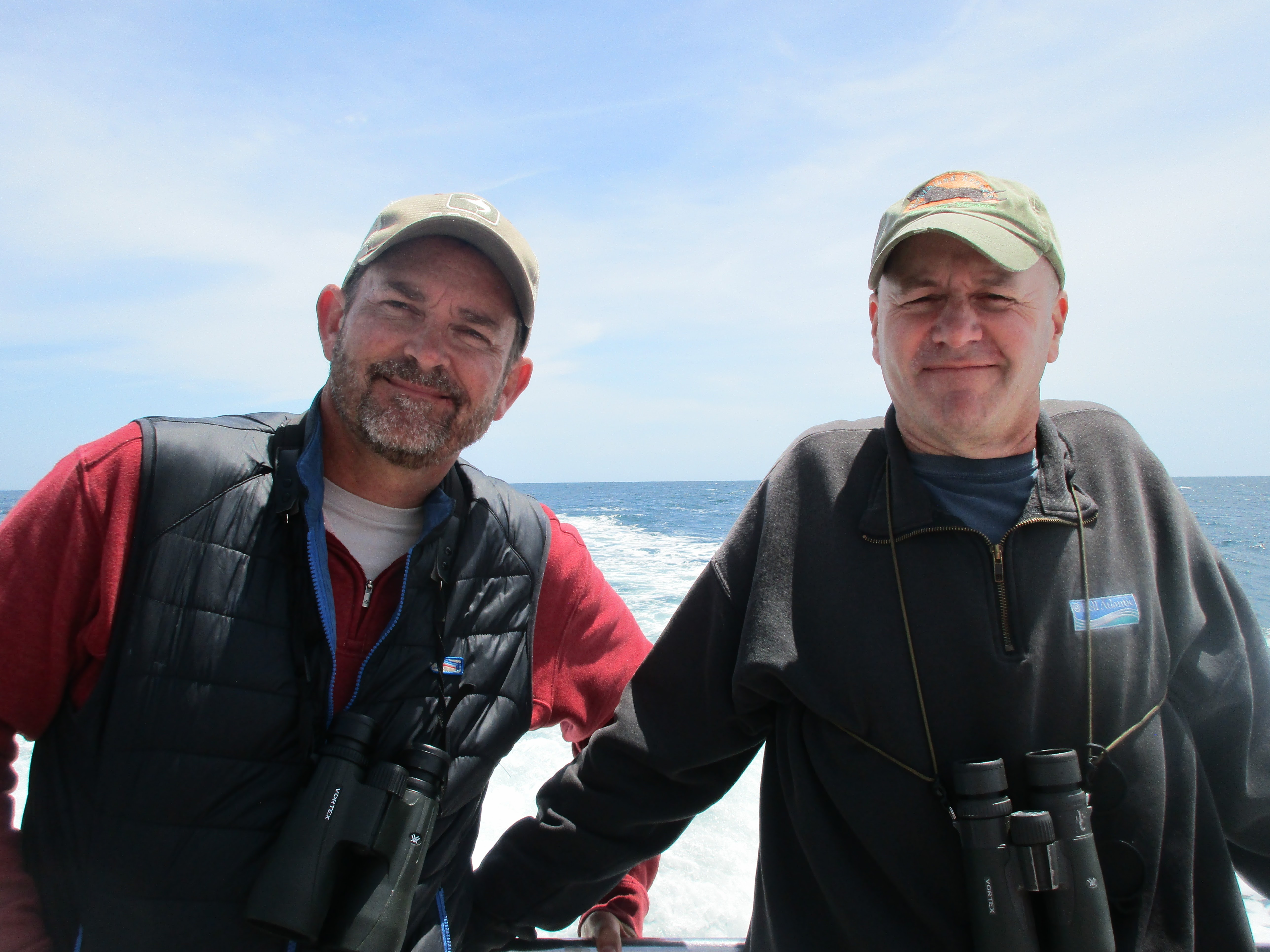
Thank you Tom


Tom on the left, his birding buddy Dave C
on the right

   For the past couple of years the president of the Ocean State Bird Club has been Tom Younkin. Tom moved to the Chicago area a couple of months ago and decided to step down. He has been back and forth to the Rhode Island area a few times the last few months so he has been around. He has run board meeting remotely. Despite doing a very good job, even from across the country, he decided the right thing to do was step down. He sent a resignation email to the members last week.

   Tom will be very much missed and it is all of our loss that he is leaving us. Tom was only a board member for one year when he became president. No one else really wanted the job and he stepped up. During the year that he was a board member, we were still experiencing COVID. So there really wasn't much to do. When he became president, he did not have the luxury of seeing how the club ran during normal times. He really went in cold. I remember thinking it would be really hard for him to attempt to run the club without the benefit of seeing how a president would run it had it been pre=COVID.

    Well, it turned out, better him than me. From our very first meeting putting our agenda together he nailed it. He was a leader right from the beginning. Without any real experience he took charge and as things started going back to normal so did the club.

   It is actually very easy to sit hear and write down Tom's list of accomplishments and contributions to not only the club but also to the Rhode Island birding community. From the beginning Tom wanted to give back. He lead a binocular drive. We passed the word and ended up having about forty binoculars donated, some new, that went to kids in urban communities. While the club got the credit for this, this project was Tom's baby from the beginning and he deserves all the credit in the world.

   The next year, we followed up the binocular drive with a field book drive. Though I don't know the exact number, we collected a large amount of field guides and they were donated to youth also. Like the binoculars, these field guides were donated to individual kids. They were not donated to classrooms where they would collect dust fifty one weeks a year. Instead they are in the hands of kids that can use them everyday. Who knows, one or more of those kids will grow up to become Rhode Island's next great birder.

    Tom was instrumental in getting Noah Stryker as a guest speaker in 2022. Tom did all of the hands on work. He contacted Noah, handled the behind the scenes planning, and even had Noah stay at his place. The day was a success. Noah went birding with twenty members in the morning then did an excellent presentation at RIC where over seventy members came to see him.

   His other grandiose plan that he made happen was the RI Cup. The RI Cup is a one day big day competition. Each species is awarded a point value, common birds are a one and mega-rarities are a five. At the end of the day teams meet to have their score tallied. Tom had wanted to have a competition like this for a while. He had the trophy made. This time he did have a committee to help him, but he was the committee chair and did the most work. 

   These are just some of the things that Tom has done that both bird club members and community members have  benefited from. Behind the scenes there has been that much more. Tom's enthusiasm has been infectious. He is always trying to grow the club. He always wants to get the word out about us. His motto is he wants the cost of membership to be the best money you spend all year. On top of everything else, Tom has lead many member only walks.

   Tom did such a great job that none of us would have challenged him to be the next president. He had our full support. While it is a huge loss for the club that Tom has stepped down, we are very lucky to have had him run the club the last couple of years. His accomplishments such as starting the RI Cup will be felt by members for years to come. Thank you Tom!

Veteran's Day Duck Observation at Trustom Pond

 While I do not normally blog about walks I lead or are lead by the OSBC I almost feel like I have to today. By far, I had more people show up to this "outing" than I ever have. Today, Tim Metcalf and I stationed ourselves at the observation deck at Osprey Point from 2:30-4 pm. We had scopes and the goal was to find ducks (and other birds) on Trustom Pond. It wasn't a "walk" because we were in one place and people could come and go as they pleased.

    When we pulled into the lot it was full. I found the last available place to park (it wasn't a space, just an opening between cars parked along the edge). We walked out and got to the observation deck at exactly 2:30. There was already a dozen people out there. Many of them were waiting for us! We quickly set up our scopes and looked for birds. 

   Unfortunately, the pond did not have thousands of ducks. There weren't any rarities. At first this bummed me out a little bit because I wanted everyone to be happy. But... I was reminded why we do bird walks in the first place. First off, the people there were thrilled at how nice it was out. They were right because we lucked out. I was down to shorts and a t-shirt. The weather alone made most of the participants happy.

    There were some Common Goldeneyes directly in front of us and I had multiple people see them in  the scope. Tim found some Coots way out but they were very clear with the afternoon sun shining on them. Tim also spotted a Horned Grebe which proved difficult to get everyone on thanks to their desire to dive for food. 

   An hour in, one participant said she had gotten five lifers! It turned out she was from Indians and just moved here. Also, this was her first year of birding. When she told me that I perked up! Now I had this new goal to find her some more lifers. I ended up getting the grebe in my scope and she got it as a lifer. Another woman also needed it for a lifer and Tim got it in his scope. We also got good, if not distant, looks at another lifer for her, a Northern Harrier. 

   All in all it was a great afternoon. Our ninety minutes flew by. We had conversations about everything from the Steller's Sea Eagle to snakes in Illinois ( I may have started that conversation). I talked with a seasoned pro about BioBlitz's from the past and future. People got lifers, and oh yeah, it was really beautiful day 

When Birding isn't fun


Sue's photo of yesterday's Royal Tern

   Truth be told, I haven't birded that much since the spring. While I spent almost everyday during the first three weeks of May birding (went to Mia eight days in a row) since then I haven't birded much. The last week of May I went to New Hampshire fishing for Smallmouth and trout. When I got back I participated in my first BioBlitz which was amazing. I got four lifer vertebrates and made new friends.

   Despite the lack of birding, I've still been spending a lot of time in nature. Since BioBlitz, I've went back to New Hampshire trying for Smallmouth Bass and Mourning Warblers. However, what has been taking up most of my time has been herping. I've been looking for reptiles and amphibians every chance I get. One of the days that Trustom was closed I saw my lifer Eastern Musk Turtle in Wakefield. Last Saturday I went to Connecticut and saw Copperheads with Charles Avenengo and Laurie, also a lifer. Even when I'm not chasing lifers, my local evening nature walks have my eyes glued to the ground looking for snakes, frogs, and toads. It has been rewarding.

   However, since I usually herp alone, I miss my birding friends. So, birding has really been a social activity for me this year. When I've actually spent time in the field looking up instead of down, it is with other people. I really haven't cared about what birds I saw as much as I cared about hanging out. Even still, I haven't seen my birding friends nearly as much as I've liked.

   Despite telling you I don't care what I've seen, there has been one bird driving me bananas and that is Royal Tern. Royal Terns are a large tern species. They are a bird that lives south of us but usually one or two will be spotted in Rhode Island each year. The problem with them is they usually don't stick around long. If one is spotted at the Charlestown Breachway while you are at work, it is almost pointless to chase it after work. They usually fly within a few minutes of being seen and many sightings are just flyovers anyway. 


Royal Tern's, Sanibel Island, FL

    A Royal Tern in Rhode Island has been the bane of my existence over the last half decade. I have chased this bird so many times and have come up short each time. There have been other times when one will show up on the only day I have plans during the week and I can't go. My birding stories of missing this bird go back years and each of those years has at least one disappointment.  To make things worse, I'm only chasing a state bird. It isn't a lifer for me as I've seen them in New Jersey, Delaware, and Florida. I'll put it this way, when one is reported, my reaction is roughly the same as when driving and after turning a corner you see an unexpected traffic jam. I tilt my head back and say the words that WTF stand for!

   This year alone has been torturing me. My friend Barbara Seith seems to be a Royal Tern magnet this year. She has seen them on multiple occasions. A few weeks ago she found one (or some, I don't remember the exact number) at Quonny. It just so happened that I had plans that day and I couldn't go chase. And as I said, chasing them is risky because they fly off most of the time anyway. Well, for the first time in my birding memory, the Royal Tern stayed at Quonny all day! If you were willing to stay for two hours, at some point they (it?) made an appearance. I was being tortured by reports as late as 8 pm.

   The following day, Barbara again finds terns. This time there were two at Brenton Point. I read the report and I'm in my car in five minutes. It is an hour and twenty minute drive but I don't care. By the time I got there the Royals were gone. I walked the shoreline for the next two and a half hours but they never reappeared. Stories like this have happened over and over again.

   I won't bore you with every dip over every year but one from a few years back at Napatree may be the worst. I was out there with Jan StJean and Sue Palmer. We walked around the lagoon and looked at birds in the rack. When it was time to leave I just walked across the channel. Jan and Sue walked all the way around the lagoon. I thought it was fun to photograph a friendly Semipalmated Plover while I waited for them. That was until they told me they had a Royal Tern flyover near the point. I said "of course you did" as I tried not to get sick to my stomach.

   Over the past weekend Barbara again found Royal Terns at Quonny so I knew they were still around. I had plans with Sue to go clamming on Wednesday so I figured I'd go to Quonny really early and hope the terns made an appearance. I got up  before my alarm and rushed down. Barbara, Linda Gardrel, and John Bean were all there. The bird didn't show while I was there and I left at 10:30 to meet Sue. I had fun talking with everyone so, despite the dip, a good morning. That night, Linda went back and had the terns at 6 pm!!!

   Thursday morning, Barbara texted me that they appeared at 6 am. I had plans for Thursday and couldn't go. Also, it is getting really frustrating blowing thirty five dollars worth of gas just to drive home empty handed. This was why I tried the day I went clamming. So I could do a two for one deal. I decided I would try again Friday.

   So Friday July 14 would be my day of reckoning. My plan was to stay at Quonny all day. If I didn't see the Royal Terns I was not going to chase them again. I woke up later than I hoped and didn't make it to Quonny until 8:40. Barbara had seen the terns flying over the sandbar in the rain about 6 am. I live too far away to ever make it to Quonny at 6 am, so I didn't feel bad about missing them. I was just glad to know they were still around. 

   Throughout the morning it rained on and off. For over an hour I was relegated to my car due to lightning all around. At 1:30 pm it cleared up for good. Till this point I hadn't seen any Royal Terns and as you can imagine I was frustrated. At 3:15 I left to get something to eat. I didn't pack food and only had eaten a banana on my way down. I got back at 4:15 and met Sue there who was willing to give me moral support and another set of eyes. 

  An hour later as I was looking west into the glare, Sue was looking straight across to the north. She said, "this tern looks good for Royal. It was clearly a big tern, much bigger than the Commons we had seen. We kept an eye on it and when it turned sideways to us we could see the huge light orange bill without any black on the tip. Finally! We watched it head west into the glare. We got some crappy pictures of it. Sue lightened one up and sent it to me as I was driving home. 

   You might think there was joy from finally seeing this species after so many failures. But there was no jubilation at all. I was just glad to get it over with. It was the same feeling as when your done washing a lot of dishes or when you've wrapped your last Christmas present. It was just a relief to be done with it. 

  For me, I stopped doing a year list a couple of years ago (you can read about it in a post). I stopped doing the year list because I was chasing everything. I got anxiety from fairly rare birds that I'd seen before but might miss. I was too competitive and after a couple years of being close to the top it was no longer fun. Instead of hanging with my buds on Saturdays, I'd go chase the birds they (retired) had found during the week. Once I stopped year listing birding became fun again. 

   However, a state bird is much different than a year bird. Except for Pacific Loon, Royal Tern is probably the only species that shows up almost every year that I hadn't seen. I had already put so much effort into finding one that I really needed to "accomplish" my goal. As I said, I'd seen them in three states. I also could not improve on my photos since they were landing at my feet as the tide rose on Sanibel Island. I looked for it so many times in RI, that despite those things, for me, it was important.

   Now that this chase is over, I'm hoping to get back to the joys of birding again. The shorebirds are in and I do love me some shorebirds. Next week I'm going birding with my dear friend Scott. We always have great conversations. I spent a lot of time with Sue this week which was definitely a bonus.

   If you spend enough time birding, we are all going to have our shares of ups and downs. We are all going to have a nemesis bird. When the Common Gull was found by Sam Miller, Tim Metcalf and I were the last ones to see it before it flew. Conversely, last year, I was the first person to miss the MacGillvaray's Warbler. It was still in the bushes but it never came out the rest of the day. When I did a RI big year in 2019 my nemesis (besides Royal Tern) was Purple Finch. It tortured me. Ironically, I saw one in January of 2020! All of this is just part of birding.

   I've said many times that birding should be fun. There are an infinite number of ways it can be enjoyable. Some of us like taking photos. Others keep lists from every state, town, year, and even a tree list in their yard. Some people just watch their feeders while others may take a trip to South Africa. The point is there is no wrong way to bird. As long as you have fun that is all that matters. For me, I love taking photos and I love spending time with my bird pals. I'll still chase state birds, and probably should have chased more (like the Frigatebird). Now that I have the Royal Tern checked off, birding will be fun again. And if no one is around to go birding with, there are always Black Racers to look for!

I know many people don't like snakes, but I also know many Rhode Islanders have never seen a venomous Copperhead. So below there is a photo of one of the Copperheads I saw in Connecticut. I put it at the bottom of the post so anyway that doesn't want to see it doesn't have to. Scroll down if you are interested.


Wood Frogs (and some locations)


   Right now is the right time to see Wood Frogs in vernal pools in Rhode Island and Massachusetts. Wood Frogs take to vernal pools to find a mate and spawn in early spring. The males try to impress a female by making a quacking sound. I make a point every spring to see the Wood Frogs in the vernal pools. For me it feels as though I am saying hello to old friends. Seeing them, along with catching trout (in Mass) is truly the very beginning of spring.
   Over the weekend I went to multiple locations many of which had more than one vernal pool. Every single vernal pool I went to had Wood Frogs in it. I even went to a location in Norton, MA owned by the town preservation society that I had never been to before. I found eight different pools ranging from small ponds to puddles and all eight had Wood Frogs!
   I'd like to help you out with locations throughout the state that have vernal pools but I have enough places close to me in MA that I don't really have to chase them so I only know a couple spots in Rhode Island.
 In South County the Kettle Pond NWR has a vernal pool (I think it is actually Kettle Pond). If you pull into the lot and walk down the trail to Kettle Pond you should hear them before you see them.
   The Cumberland Monastery has multiple places where you will at least hear the frogs. You have a better chance of seeing them if you wear muck boots as the trails are muddy this time of year. If you wander the backside of Lincoln Woods off trail there are multiple vernal pools. I discovered them one year, too late to see any frogs. 
   

   Another good spot is Lime Rock Preserve, Lincoln owned by The Nature Conservancy. Once parked walk the trail that goes up the hill to the right. Once up the hill, just after you crest it, you will see a pool to your right. Walk to any spot with an opening and wait. Bring a towel to sit on because the ground can be wet.
   I have heard Wood Frogs in vernal pools at Great Swamp. There are many pools. Though I have never heard/seen any in the little pools just up from the parking lot, I have seen tadpoles of some species of amphibian. There are also pools hidden from trails that I only know about because  I heard frogs and went exploring ( I'm not holding out here, I just wouldn't know how to explain where they are)
   There are two very good spots not too far from Rhode Island. The closest is the Attleboro Springs Sanctuary in Attleboro. Once parked walk straight down the trail. Take a right at the first trail junction. You will walk along a pond which is loaded with bullfrogs and green frogs during warmer months. You will pass a dock at the far corner of the pond. Keep hugging the pond anther fifty feet. Just passed the pond there will be a vernal pool that goes under the boardwalk. There are many Wood Frogs and since boardwalk goes right over them, they have no fear of people and make wonderful photo subjects.
 

   My favorite place in the world to see Wood Frogs in Moose Hill Sanctuary in Sharon, MA. At the parking lot there is a wooden fence, where there is a space in the fence, walk through it and take the trail that goes right. Follow this trail over a couple of small hills for about five minutes. You will come to two vernal pools, one on each side of the trail. The first, on the right, is down a very steep hill. Don't bother going down there. Though you will see Wood Frogs from the trail in your binoculars. Keep walking and within thirty more seconds another pool will be on your left. There are a couple of side trails that lead to the water's edge. Again, a towel is helpful. You won't need to wait long to see frogs. Some of them will be curious about you and come to within a foot of the shoreline. All the little bumps in the water are Wood Frogs and not the top of sticks. I could sit here for hours. 
   The best piece of advice I can give is go see Wood Frogs as soon as you can. They don't stay long. There have been multiple times I've found Wood Frogs and brought a friend just a few days later and the water was deserted.
   Lastly, as I've said before the birding community is stronger if we help each other. If anyone reading this knows of other easy spots to see Wood Frogs, I ask you to write it in the comments on the OSBC Facebook page under this link.  Hopefully, we can have spots listed all across the state. Thanks for reading.
 

Woodcock Locations and Tips


You're not going to get a look like this when they 
display, but they will be interesting to watch.

   Right now is the right time to see American Woodcocks do their mating dance. Their ritual is one of the weirdest for a North American bird. They start the ritual a little past sunset when the male repeatedly makes a sound that sounds like a "peent". Then it flies up into the air in a strange flight that can go up to three hundred feet. Then it comes almost straight down at lightning speed and lands to do it all again.

  Woodcocks start their dance near dark. I tell people that they will start flying the second it is too dark to take a photo. I know many people are interested in seeing the Woodcock mating display. I suspect some people just don't know where to start while others may be put off because they will be driving home in the dark. I can't help you with the latter, but I can shorten the trip. I asked a bunch of birders throughout the state where to see Woodcocks display. They gave me spots throughout the state. Hopefully one of them is close enough for you to go see them.

  First some tips (and a story). I went to Daniel Webster Wildlife Sanctuary in Marshfield, MA last week. We walked the trails and stayed late enough to see the Woodcocks. Also there was a lady that has heard them "peent" but hadn't actually seen one take off in her life. Daniel Webster is a great place to see Woodcocks display. There are a lot there and they are pretty much a sure bet. We talked to the lady as she staked out her spot near the field. We went up the small hill to the observation stand (I can't call it a tower, it is only three feet high. From our vantage point we had the same field in front of us. The tree line was at least 150 feet from us and we looked towards the sunset. 

   Sure enough we had Woodcocks. I heard at least seven all at once. We had great displays as we saw countless Woodcocks. They started while it was still light enough to follow them in the binoculars. We really couldn't see them go up until they cleared the tree line. Once in the sky they were easy to spot. It was cold and we had our fill after a few flights. We walked back towards the woman, pretty excited that she must have had great looks. She told us she didn't see any go up!

   I realized that she had put herself in a bad spot. Because she was so close to the trees she never saw them clear the tree line and get into the sky. I felt terrible for her. If I'd have known I'd have been happy to call her over. 

      Finally some useful advice-

So my advice is to try to give yourself a good sightline if you can. Back up to the far edge of a field. If you can get up high it will also help. Even if that elevation is only a few feet it could help. Lastly, the brightest part of the sky will be towards the setting sun. If Woodcocks happen to fly in that direction you will get better looks

Locations-

Honestly, when I want to go see Woodcocks in RI I just go to the Cumberland Monastery. It is only thirteen minutes from my house. However, I have seen them in other locations. Below is a list of locations I've seen them at or places birders I asked have seen them

Cumberland- Cumberland Monastery

Johnston- Snake Den (inconsistent)

South County- Trustom, Ninigret, Great Swamp

East Bay- Touisset Refuge (Warren) Mt Hope Farm (Bristol) Colt State Park (Bristol)

                I fully suspect Doug Raynor in Barrington

Aquidneck Island-  Norman Bird Sanctuary, Sachuest NWR (inconsistent) 

Jamestown- Fort Getty Rd,

Coventry area- Tillinghast Pond Management Area (loaded), the fields above Carbuncle Pond

Chepachet- Douglas Hill Road and Snake Hill Road


Thanks to Sue Palmer, Jess Bishop, Jan St Jean, Catherine Boisseau, Matt Schenck Al Schenck (not related), Mike Tucker, and Louise Ruggeri

Rhode Island Species Record broken in 2022!


Tim and Erin Metcalf on the pelagic
where we saw a Northern Pulmar.

   Under the category of better late than never, this blog post should have been written the first week of January. 

  Last year, the record for the number of species seen by a birder was broken by Tim Metcalf. The previous record was held by Carlos Pedro . Carlos ended up getting three hundred and nine species in 2020. This broke the previous record of 306 which was held by Jan StJean for many years.

   Tim shattered the record getting an unheard of number of 313. In December he tied the record with an Eared Grebe. After the grebe he got Red Crossbills, Ross's Goose, Tundra Swan,  and Sabine's Gull to end up at 313.

   I did two Rhode Island Big Year's and I chased every bird I could in 2019 and 2020. Those two years I ended up with 291 and 294 respectively. I can not tell you the level of commitment it took for me to reach those numbers. So it goes without saying, to get over three hundred species really is a year long commitment. So getting another thirteen species after reaching the holy grail of 300 is truly an epic year. 

  It is one thing to chase birds that other's have found but Tim is out just about everyday birding. His wife Erin told me that around 4 am Tim starts getting fidgety and restless in bed because he wants to be birding. The best bird Tim found on his own along with many others was a Sabine's Gull which I believe he saw at Pier 5 in Narragansett.

  Along with seeing birds on land, Tim was on the water a lot. He took the Block Island Ferry eleven times, not to visit the Block, but just look for birds in the water (best and really only place to see Black Guillemot are the waters below the cliffs at the north end while on the ferry). He took a dedicated pelagic on the Francis Fleet where he saw Norther Fulmar (I was on that trip and it was a lifer for me). He also went on multiple whale watches out of Galilee, again, not for whales but for birds. Between the dedicated pelagics and whale watches, he went out in the open ocean five times.

   Tim is a good friend of mine and we bird a lot. I had Friday's off from work in the spring and three weeks in a row we went to Great Swamp in the afternoon looking for early migrants. Each week while we were at the swamp we would get a message that a rare bird was reported. The rarest of these was a Common Gull found by Sam Miller at the Narragansett Sea Wall. We had to double time it back to our cars to go for these birds. We got very lucky with the Common Gull. We just made it to the seawall in time to see it. We watched for about 15 minutes then it decided to fly in a southernly direction. We were the last two to see it. I stuck around for another 90 minutes trying to help other birders that showed up to find it but it was no use. The bird was gone.

   I do not know if Tim's record will be broken any time soon. Anyone going for the record would need a lot of luck. First off, it would have to be a good finch year. Many years Crossbills, Grosbeaks, and Pine Siskins just don't come south. You'd need all the waterfowl to show including Canvasback and Tundra Swans along with rare geese such as Cackling and Ross's. You would also need quite a few rarities that you can never predict such as the Sabine's Gull Tim found.

   Lastly, you would need the burning drive to follow through all year. You can't take days off. Sure you might not plan on birding a particular day, but if that text comes in that there is a Tropical Kingbird at Watch Hill or a Pink Footed Goose in Tiverton you jump in the car and go try for it. You dip on one hundred percent of the birds you don't chase. Tim got lucky with so many rarities showing up, but he chased them all along with the finches. Most importantly, he put in his time. So this may be two months too late but congratulations to Tim Metcalf!

Upcoming Events including Info on Noah Stryker's Talk


The Ocean State Bird Club has a few events in the upcoming couple of weeks that we are really excited about. The highlight is Noah Strycker coming to Rhode Island in September. More on that below. Our upcoming events are the following...


Birds And Beer-

   This is a get together at a local brewery that we do a few times a year. A bunch of us will get together and talk about birds over a pint or two. We usually spend a couple of hours talking about what we have seen and where we will be going. These events are for members only. They are very well attended as they usually have more people show up than do our walks. Members have received an email with the date and time of the next one. If this is of interest to you, consider joining the club.


Ocean State Bird Club Pelagic-

   We are planning on chartering one of the Francis Fleet boats this fall for a dedicated pelagic. Unlike the above event it will be open to non-members, however, members will get a discounted price. We are tentatively looking at the last week of September for this. Payment will have to be in advance because chartering a whale watch boat (with crazy fuel costs) is not cheap. Once we get a date set in stone, I/we will post the information as soon as possible. Stay tuned. I love pelagics and am very excited we are doing this.

Noah Strycker- 

   Bird Club President Tom Younkin worked really hard to get Noah Strycker to come to Rhode Island to do a talk and a walk. Other board members worked just as hard to help find a venue to host the seminar. I personally have seen Noah's talk when the Brookline Bird Club had him as a guest speaker. I can tell you honestly his talk is great. He is funny and he is well spoken. He details his trip around the world eloquently. I really enjoyed it. When Tom said there was the possibility of booking Noah, I was one hundred percent all for it from the get-go. The event is FREE to members. As a board, we are really excited to give this presentation to our members as a thank you for sticking with us through Covid. 

   Below is Tom's write up about the upcoming event. Since I cannot improve on the information I copied and pasted it from his email. The Key Date to Remember is September 10!


  In 2015 Noah Strycker recorded 6,042 bird species in a single year across the planet! At the time he established a new record for the number of species seen around the globe in one year!  He is widely regarded as one of the foremost birders in the world.  In 2017 he published a best-selling book entitled “Birding without Borders” detailing his adventures on this epic quest.  


   The Ocean State Bird Club is proud to announce that we are hosting a special event with Noah Strycker! On September 10th, he will be recounting his incredible journey in his "Birding without Borders" presentation.  We are very excited that he has agreed to come in from the West Coast to speak with our Club and additional guests. OSBC members can attend the event at no cost. Please spread the word to your friends and family, they may attend this event by simply joining the OSBC for $15 or they may purchase a ticket at the door for $20. This event will take place at 2pm at Gaige Hall on the campus of Rhode Island College in Providence.  Bring your copy of "Birding without Borders" and he will gladly sign it!  You can learn more and register on our website, www.oceanstatebirdclub.org.  We hope to see you there!