When Birding isn't fun


Sue's photo of yesterday's Royal Tern

   Truth be told, I haven't birded that much since the spring. While I spent almost everyday during the first three weeks of May birding (went to Mia eight days in a row) since then I haven't birded much. The last week of May I went to New Hampshire fishing for Smallmouth and trout. When I got back I participated in my first BioBlitz which was amazing. I got four lifer vertebrates and made new friends.

   Despite the lack of birding, I've still been spending a lot of time in nature. Since BioBlitz, I've went back to New Hampshire trying for Smallmouth Bass and Mourning Warblers. However, what has been taking up most of my time has been herping. I've been looking for reptiles and amphibians every chance I get. One of the days that Trustom was closed I saw my lifer Eastern Musk Turtle in Wakefield. Last Saturday I went to Connecticut and saw Copperheads with Charles Avenengo and Laurie, also a lifer. Even when I'm not chasing lifers, my local evening nature walks have my eyes glued to the ground looking for snakes, frogs, and toads. It has been rewarding.

   However, since I usually herp alone, I miss my birding friends. So, birding has really been a social activity for me this year. When I've actually spent time in the field looking up instead of down, it is with other people. I really haven't cared about what birds I saw as much as I cared about hanging out. Even still, I haven't seen my birding friends nearly as much as I've liked.

   Despite telling you I don't care what I've seen, there has been one bird driving me bananas and that is Royal Tern. Royal Terns are a large tern species. They are a bird that lives south of us but usually one or two will be spotted in Rhode Island each year. The problem with them is they usually don't stick around long. If one is spotted at the Charlestown Breachway while you are at work, it is almost pointless to chase it after work. They usually fly within a few minutes of being seen and many sightings are just flyovers anyway. 


Royal Tern's, Sanibel Island, FL

    A Royal Tern in Rhode Island has been the bane of my existence over the last half decade. I have chased this bird so many times and have come up short each time. There have been other times when one will show up on the only day I have plans during the week and I can't go. My birding stories of missing this bird go back years and each of those years has at least one disappointment.  To make things worse, I'm only chasing a state bird. It isn't a lifer for me as I've seen them in New Jersey, Delaware, and Florida. I'll put it this way, when one is reported, my reaction is roughly the same as when driving and after turning a corner you see an unexpected traffic jam. I tilt my head back and say the words that WTF stand for!

   This year alone has been torturing me. My friend Barbara Seith seems to be a Royal Tern magnet this year. She has seen them on multiple occasions. A few weeks ago she found one (or some, I don't remember the exact number) at Quonny. It just so happened that I had plans that day and I couldn't go chase. And as I said, chasing them is risky because they fly off most of the time anyway. Well, for the first time in my birding memory, the Royal Tern stayed at Quonny all day! If you were willing to stay for two hours, at some point they (it?) made an appearance. I was being tortured by reports as late as 8 pm.

   The following day, Barbara again finds terns. This time there were two at Brenton Point. I read the report and I'm in my car in five minutes. It is an hour and twenty minute drive but I don't care. By the time I got there the Royals were gone. I walked the shoreline for the next two and a half hours but they never reappeared. Stories like this have happened over and over again.

   I won't bore you with every dip over every year but one from a few years back at Napatree may be the worst. I was out there with Jan StJean and Sue Palmer. We walked around the lagoon and looked at birds in the rack. When it was time to leave I just walked across the channel. Jan and Sue walked all the way around the lagoon. I thought it was fun to photograph a friendly Semipalmated Plover while I waited for them. That was until they told me they had a Royal Tern flyover near the point. I said "of course you did" as I tried not to get sick to my stomach.

   Over the past weekend Barbara again found Royal Terns at Quonny so I knew they were still around. I had plans with Sue to go clamming on Wednesday so I figured I'd go to Quonny really early and hope the terns made an appearance. I got up  before my alarm and rushed down. Barbara, Linda Gardrel, and John Bean were all there. The bird didn't show while I was there and I left at 10:30 to meet Sue. I had fun talking with everyone so, despite the dip, a good morning. That night, Linda went back and had the terns at 6 pm!!!

   Thursday morning, Barbara texted me that they appeared at 6 am. I had plans for Thursday and couldn't go. Also, it is getting really frustrating blowing thirty five dollars worth of gas just to drive home empty handed. This was why I tried the day I went clamming. So I could do a two for one deal. I decided I would try again Friday.

   So Friday July 14 would be my day of reckoning. My plan was to stay at Quonny all day. If I didn't see the Royal Terns I was not going to chase them again. I woke up later than I hoped and didn't make it to Quonny until 8:40. Barbara had seen the terns flying over the sandbar in the rain about 6 am. I live too far away to ever make it to Quonny at 6 am, so I didn't feel bad about missing them. I was just glad to know they were still around. 

   Throughout the morning it rained on and off. For over an hour I was relegated to my car due to lightning all around. At 1:30 pm it cleared up for good. Till this point I hadn't seen any Royal Terns and as you can imagine I was frustrated. At 3:15 I left to get something to eat. I didn't pack food and only had eaten a banana on my way down. I got back at 4:15 and met Sue there who was willing to give me moral support and another set of eyes. 

  An hour later as I was looking west into the glare, Sue was looking straight across to the north. She said, "this tern looks good for Royal. It was clearly a big tern, much bigger than the Commons we had seen. We kept an eye on it and when it turned sideways to us we could see the huge light orange bill without any black on the tip. Finally! We watched it head west into the glare. We got some crappy pictures of it. Sue lightened one up and sent it to me as I was driving home. 

   You might think there was joy from finally seeing this species after so many failures. But there was no jubilation at all. I was just glad to get it over with. It was the same feeling as when your done washing a lot of dishes or when you've wrapped your last Christmas present. It was just a relief to be done with it. 

  For me, I stopped doing a year list a couple of years ago (you can read about it in a post). I stopped doing the year list because I was chasing everything. I got anxiety from fairly rare birds that I'd seen before but might miss. I was too competitive and after a couple years of being close to the top it was no longer fun. Instead of hanging with my buds on Saturdays, I'd go chase the birds they (retired) had found during the week. Once I stopped year listing birding became fun again. 

   However, a state bird is much different than a year bird. Except for Pacific Loon, Royal Tern is probably the only species that shows up almost every year that I hadn't seen. I had already put so much effort into finding one that I really needed to "accomplish" my goal. As I said, I'd seen them in three states. I also could not improve on my photos since they were landing at my feet as the tide rose on Sanibel Island. I looked for it so many times in RI, that despite those things, for me, it was important.

   Now that this chase is over, I'm hoping to get back to the joys of birding again. The shorebirds are in and I do love me some shorebirds. Next week I'm going birding with my dear friend Scott. We always have great conversations. I spent a lot of time with Sue this week which was definitely a bonus.

   If you spend enough time birding, we are all going to have our shares of ups and downs. We are all going to have a nemesis bird. When the Common Gull was found by Sam Miller, Tim Metcalf and I were the last ones to see it before it flew. Conversely, last year, I was the first person to miss the MacGillvaray's Warbler. It was still in the bushes but it never came out the rest of the day. When I did a RI big year in 2019 my nemesis (besides Royal Tern) was Purple Finch. It tortured me. Ironically, I saw one in January of 2020! All of this is just part of birding.

   I've said many times that birding should be fun. There are an infinite number of ways it can be enjoyable. Some of us like taking photos. Others keep lists from every state, town, year, and even a tree list in their yard. Some people just watch their feeders while others may take a trip to South Africa. The point is there is no wrong way to bird. As long as you have fun that is all that matters. For me, I love taking photos and I love spending time with my bird pals. I'll still chase state birds, and probably should have chased more (like the Frigatebird). Now that I have the Royal Tern checked off, birding will be fun again. And if no one is around to go birding with, there are always Black Racers to look for!

I know many people don't like snakes, but I also know many Rhode Islanders have never seen a venomous Copperhead. So below there is a photo of one of the Copperheads I saw in Connecticut. I put it at the bottom of the post so anyway that doesn't want to see it doesn't have to. Scroll down if you are interested.


Wood Frogs (and some locations)


   Right now is the right time to see Wood Frogs in vernal pools in Rhode Island and Massachusetts. Wood Frogs take to vernal pools to find a mate and spawn in early spring. The males try to impress a female by making a quacking sound. I make a point every spring to see the Wood Frogs in the vernal pools. For me it feels as though I am saying hello to old friends. Seeing them, along with catching trout (in Mass) is truly the very beginning of spring.
   Over the weekend I went to multiple locations many of which had more than one vernal pool. Every single vernal pool I went to had Wood Frogs in it. I even went to a location in Norton, MA owned by the town preservation society that I had never been to before. I found eight different pools ranging from small ponds to puddles and all eight had Wood Frogs!
   I'd like to help you out with locations throughout the state that have vernal pools but I have enough places close to me in MA that I don't really have to chase them so I only know a couple spots in Rhode Island.
 In South County the Kettle Pond NWR has a vernal pool (I think it is actually Kettle Pond). If you pull into the lot and walk down the trail to Kettle Pond you should hear them before you see them.
   The Cumberland Monastery has multiple places where you will at least hear the frogs. You have a better chance of seeing them if you wear muck boots as the trails are muddy this time of year. If you wander the backside of Lincoln Woods off trail there are multiple vernal pools. I discovered them one year, too late to see any frogs. 
   

   Another good spot is Lime Rock Preserve, Lincoln owned by The Nature Conservancy. Once parked walk the trail that goes up the hill to the right. Once up the hill, just after you crest it, you will see a pool to your right. Walk to any spot with an opening and wait. Bring a towel to sit on because the ground can be wet.
   I have heard Wood Frogs in vernal pools at Great Swamp. There are many pools. Though I have never heard/seen any in the little pools just up from the parking lot, I have seen tadpoles of some species of amphibian. There are also pools hidden from trails that I only know about because  I heard frogs and went exploring ( I'm not holding out here, I just wouldn't know how to explain where they are)
   There are two very good spots not too far from Rhode Island. The closest is the Attleboro Springs Sanctuary in Attleboro. Once parked walk straight down the trail. Take a right at the first trail junction. You will walk along a pond which is loaded with bullfrogs and green frogs during warmer months. You will pass a dock at the far corner of the pond. Keep hugging the pond anther fifty feet. Just passed the pond there will be a vernal pool that goes under the boardwalk. There are many Wood Frogs and since boardwalk goes right over them, they have no fear of people and make wonderful photo subjects.
 

   My favorite place in the world to see Wood Frogs in Moose Hill Sanctuary in Sharon, MA. At the parking lot there is a wooden fence, where there is a space in the fence, walk through it and take the trail that goes right. Follow this trail over a couple of small hills for about five minutes. You will come to two vernal pools, one on each side of the trail. The first, on the right, is down a very steep hill. Don't bother going down there. Though you will see Wood Frogs from the trail in your binoculars. Keep walking and within thirty more seconds another pool will be on your left. There are a couple of side trails that lead to the water's edge. Again, a towel is helpful. You won't need to wait long to see frogs. Some of them will be curious about you and come to within a foot of the shoreline. All the little bumps in the water are Wood Frogs and not the top of sticks. I could sit here for hours. 
   The best piece of advice I can give is go see Wood Frogs as soon as you can. They don't stay long. There have been multiple times I've found Wood Frogs and brought a friend just a few days later and the water was deserted.
   Lastly, as I've said before the birding community is stronger if we help each other. If anyone reading this knows of other easy spots to see Wood Frogs, I ask you to write it in the comments on the OSBC Facebook page under this link.  Hopefully, we can have spots listed all across the state. Thanks for reading.
 

Woodcock Locations and Tips


You're not going to get a look like this when they 
display, but they will be interesting to watch.

   Right now is the right time to see American Woodcocks do their mating dance. Their ritual is one of the weirdest for a North American bird. They start the ritual a little past sunset when the male repeatedly makes a sound that sounds like a "peent". Then it flies up into the air in a strange flight that can go up to three hundred feet. Then it comes almost straight down at lightning speed and lands to do it all again.

  Woodcocks start their dance near dark. I tell people that they will start flying the second it is too dark to take a photo. I know many people are interested in seeing the Woodcock mating display. I suspect some people just don't know where to start while others may be put off because they will be driving home in the dark. I can't help you with the latter, but I can shorten the trip. I asked a bunch of birders throughout the state where to see Woodcocks display. They gave me spots throughout the state. Hopefully one of them is close enough for you to go see them.

  First some tips (and a story). I went to Daniel Webster Wildlife Sanctuary in Marshfield, MA last week. We walked the trails and stayed late enough to see the Woodcocks. Also there was a lady that has heard them "peent" but hadn't actually seen one take off in her life. Daniel Webster is a great place to see Woodcocks display. There are a lot there and they are pretty much a sure bet. We talked to the lady as she staked out her spot near the field. We went up the small hill to the observation stand (I can't call it a tower, it is only three feet high. From our vantage point we had the same field in front of us. The tree line was at least 150 feet from us and we looked towards the sunset. 

   Sure enough we had Woodcocks. I heard at least seven all at once. We had great displays as we saw countless Woodcocks. They started while it was still light enough to follow them in the binoculars. We really couldn't see them go up until they cleared the tree line. Once in the sky they were easy to spot. It was cold and we had our fill after a few flights. We walked back towards the woman, pretty excited that she must have had great looks. She told us she didn't see any go up!

   I realized that she had put herself in a bad spot. Because she was so close to the trees she never saw them clear the tree line and get into the sky. I felt terrible for her. If I'd have known I'd have been happy to call her over. 

      Finally some useful advice-

So my advice is to try to give yourself a good sightline if you can. Back up to the far edge of a field. If you can get up high it will also help. Even if that elevation is only a few feet it could help. Lastly, the brightest part of the sky will be towards the setting sun. If Woodcocks happen to fly in that direction you will get better looks

Locations-

Honestly, when I want to go see Woodcocks in RI I just go to the Cumberland Monastery. It is only thirteen minutes from my house. However, I have seen them in other locations. Below is a list of locations I've seen them at or places birders I asked have seen them

Cumberland- Cumberland Monastery

Johnston- Snake Den (inconsistent)

South County- Trustom, Ninigret, Great Swamp

East Bay- Touisset Refuge (Warren) Mt Hope Farm (Bristol) Colt State Park (Bristol)

                I fully suspect Doug Raynor in Barrington

Aquidneck Island-  Norman Bird Sanctuary, Sachuest NWR (inconsistent) 

Jamestown- Fort Getty Rd,

Coventry area- Tillinghast Pond Management Area (loaded), the fields above Carbuncle Pond

Chepachet- Douglas Hill Road and Snake Hill Road


Thanks to Sue Palmer, Jess Bishop, Jan St Jean, Catherine Boisseau, Matt Schenck Al Schenck (not related), Mike Tucker, and Louise Ruggeri

Rhode Island Species Record broken in 2022!


Tim and Erin Metcalf on the pelagic
where we saw a Northern Pulmar.

   Under the category of better late than never, this blog post should have been written the first week of January. 

  Last year, the record for the number of species seen by a birder was broken by Tim Metcalf. The previous record was held by Carlos Pedro . Carlos ended up getting three hundred and nine species in 2020. This broke the previous record of 306 which was held by Jan StJean for many years.

   Tim shattered the record getting an unheard of number of 313. In December he tied the record with an Eared Grebe. After the grebe he got Red Crossbills, Ross's Goose, Tundra Swan,  and Sabine's Gull to end up at 313.

   I did two Rhode Island Big Year's and I chased every bird I could in 2019 and 2020. Those two years I ended up with 291 and 294 respectively. I can not tell you the level of commitment it took for me to reach those numbers. So it goes without saying, to get over three hundred species really is a year long commitment. So getting another thirteen species after reaching the holy grail of 300 is truly an epic year. 

  It is one thing to chase birds that other's have found but Tim is out just about everyday birding. His wife Erin told me that around 4 am Tim starts getting fidgety and restless in bed because he wants to be birding. The best bird Tim found on his own along with many others was a Sabine's Gull which I believe he saw at Pier 5 in Narragansett.

  Along with seeing birds on land, Tim was on the water a lot. He took the Block Island Ferry eleven times, not to visit the Block, but just look for birds in the water (best and really only place to see Black Guillemot are the waters below the cliffs at the north end while on the ferry). He took a dedicated pelagic on the Francis Fleet where he saw Norther Fulmar (I was on that trip and it was a lifer for me). He also went on multiple whale watches out of Galilee, again, not for whales but for birds. Between the dedicated pelagics and whale watches, he went out in the open ocean five times.

   Tim is a good friend of mine and we bird a lot. I had Friday's off from work in the spring and three weeks in a row we went to Great Swamp in the afternoon looking for early migrants. Each week while we were at the swamp we would get a message that a rare bird was reported. The rarest of these was a Common Gull found by Sam Miller at the Narragansett Sea Wall. We had to double time it back to our cars to go for these birds. We got very lucky with the Common Gull. We just made it to the seawall in time to see it. We watched for about 15 minutes then it decided to fly in a southernly direction. We were the last two to see it. I stuck around for another 90 minutes trying to help other birders that showed up to find it but it was no use. The bird was gone.

   I do not know if Tim's record will be broken any time soon. Anyone going for the record would need a lot of luck. First off, it would have to be a good finch year. Many years Crossbills, Grosbeaks, and Pine Siskins just don't come south. You'd need all the waterfowl to show including Canvasback and Tundra Swans along with rare geese such as Cackling and Ross's. You would also need quite a few rarities that you can never predict such as the Sabine's Gull Tim found.

   Lastly, you would need the burning drive to follow through all year. You can't take days off. Sure you might not plan on birding a particular day, but if that text comes in that there is a Tropical Kingbird at Watch Hill or a Pink Footed Goose in Tiverton you jump in the car and go try for it. You dip on one hundred percent of the birds you don't chase. Tim got lucky with so many rarities showing up, but he chased them all along with the finches. Most importantly, he put in his time. So this may be two months too late but congratulations to Tim Metcalf!

Upcoming Events including Info on Noah Stryker's Talk


The Ocean State Bird Club has a few events in the upcoming couple of weeks that we are really excited about. The highlight is Noah Strycker coming to Rhode Island in September. More on that below. Our upcoming events are the following...


Birds And Beer-

   This is a get together at a local brewery that we do a few times a year. A bunch of us will get together and talk about birds over a pint or two. We usually spend a couple of hours talking about what we have seen and where we will be going. These events are for members only. They are very well attended as they usually have more people show up than do our walks. Members have received an email with the date and time of the next one. If this is of interest to you, consider joining the club.


Ocean State Bird Club Pelagic-

   We are planning on chartering one of the Francis Fleet boats this fall for a dedicated pelagic. Unlike the above event it will be open to non-members, however, members will get a discounted price. We are tentatively looking at the last week of September for this. Payment will have to be in advance because chartering a whale watch boat (with crazy fuel costs) is not cheap. Once we get a date set in stone, I/we will post the information as soon as possible. Stay tuned. I love pelagics and am very excited we are doing this.

Noah Strycker- 

   Bird Club President Tom Younkin worked really hard to get Noah Strycker to come to Rhode Island to do a talk and a walk. Other board members worked just as hard to help find a venue to host the seminar. I personally have seen Noah's talk when the Brookline Bird Club had him as a guest speaker. I can tell you honestly his talk is great. He is funny and he is well spoken. He details his trip around the world eloquently. I really enjoyed it. When Tom said there was the possibility of booking Noah, I was one hundred percent all for it from the get-go. The event is FREE to members. As a board, we are really excited to give this presentation to our members as a thank you for sticking with us through Covid. 

   Below is Tom's write up about the upcoming event. Since I cannot improve on the information I copied and pasted it from his email. The Key Date to Remember is September 10!


  In 2015 Noah Strycker recorded 6,042 bird species in a single year across the planet! At the time he established a new record for the number of species seen around the globe in one year!  He is widely regarded as one of the foremost birders in the world.  In 2017 he published a best-selling book entitled “Birding without Borders” detailing his adventures on this epic quest.  


   The Ocean State Bird Club is proud to announce that we are hosting a special event with Noah Strycker! On September 10th, he will be recounting his incredible journey in his "Birding without Borders" presentation.  We are very excited that he has agreed to come in from the West Coast to speak with our Club and additional guests. OSBC members can attend the event at no cost. Please spread the word to your friends and family, they may attend this event by simply joining the OSBC for $15 or they may purchase a ticket at the door for $20. This event will take place at 2pm at Gaige Hall on the campus of Rhode Island College in Providence.  Bring your copy of "Birding without Borders" and he will gladly sign it!  You can learn more and register on our website, www.oceanstatebirdclub.org.  We hope to see you there!


Filling the Gap between Spring Migration and Shorebirds coming back


My lifer Black Racer

   Before I even start, I need to address two things. The first, this post isn't about birds. Secondly, if I would have thought about it, I should have wrote this post a month ago. The thought came to last night so I am writing it today. Everything that I am writing is still relevant but could have been useful for over a month now. I truly apologize. Now that is out of the way...

   I will be the first to admit that after migration is over I can get into a funk. I get such a high from seeing all of the warblers that June can be a letdown for me. I get "seasonal depression" worse after migration than I do when it gets dark at 4:30 in December. Despite glorious weather the first couple of weeks of the month I find myself inside the house feeling like there's nothing "worth the drive". To combat this annual phenomenon for the last few years I have taken my vacation in June. This year and last I went to the Outer Banks. 

   However, once I get back from vaca, there was still a lot of time before shorebirds show up on their way back home. This year, I have had no problem keeping busy.  

  Herping...


Northern Water Snake devouring 
a bass twice its width

    For the past month I have been looking for reptiles and amphibians. I really haven't been birding but have spent a lot of time in the woods, fields and by freshwater ponds. I think I caught the bug when I was in Florida and saw Cottonmouths last November. Then in March I actively looked for Spring Peepers. Since then, every chance I get I've been looking at the ground for herps as much as I've looked in trees for birds. 

   All summer (from June 1 on) I've been looking for snakes and rarer turtles and frogs. My first big find was seeing a Northern Water Snake eating an eight inch Largemouth Bass. Along with Sue Palmer, we watched the snake take forty five minutes to turn the bass and swallow it. Later that day I came across my lifer Black Racer.  

  This new hobby has had many moments of discovery so far. I've seen Fowler's Toads on three separate occasions. I found a second Black Racer and many more Northern Water Snakes. Yesterday I was walking along the water's edge and came across no less than nine Pickerel Frogs. 

   Seeing Bullfrogs, Green Frogs, Painted Turles, and Snapping Turtles is easy. All four of those species are very common. I've been concentrating on finding the harder species. This includes all species of snakes. Even common Garter Snakes are a challenge. When I find a snake of any species, I consider it a great day. This is also true of any frog or toad that isn't a Bullfrog or Green Frog. When I saw the Pickerel Frogs, I watched them for over a half hour. 

Northern Red Bellied Cooter and an unfortunate
branch
    I've made special trips to find herps. Just like we do for rare birds, I "chased" a turtle last week. While I was in Virginia, on my way to NC, I took photos of what ended up being Northern Red Bellied Cooters. I had to ask someone the ID. Later on when I was researching them I found out there is a population of Northern Red Bellied Cooters in Plymouth County, MA. There are no other Red Bellied Cooters for 200 miles. The next closest population is in New Jersey. They are an endangered species in Massachusetts. There happens to be a national wildlife refuge in Plymouth specifically to protect the Cooters. However, it off limits to the public. I looked at a map of the area and saw multiple ponds just outside the refuge border. I took a trip to scout for public access. It turns out those ponds were very private, but I did end up seeing the cooters on state property in Plymouth. Needless to say, I felt very accomplished. 

   I'm pretty much addicted to chasing herps now. I'm keeping a list of species I've seen and where I saw them. Even if I only have an afternoon after work, I'll go look for a roadside lily pad filled pond or look for snakes along a wooded trail. Finding herps is challenging. I think it is much harder than finding birds. Finding snakes can feel like work. It took me almost four hours of walking through the woods and along a canal before I found my one and only snake yesterday (Northern Water Snake) but what a treat when I saw it.

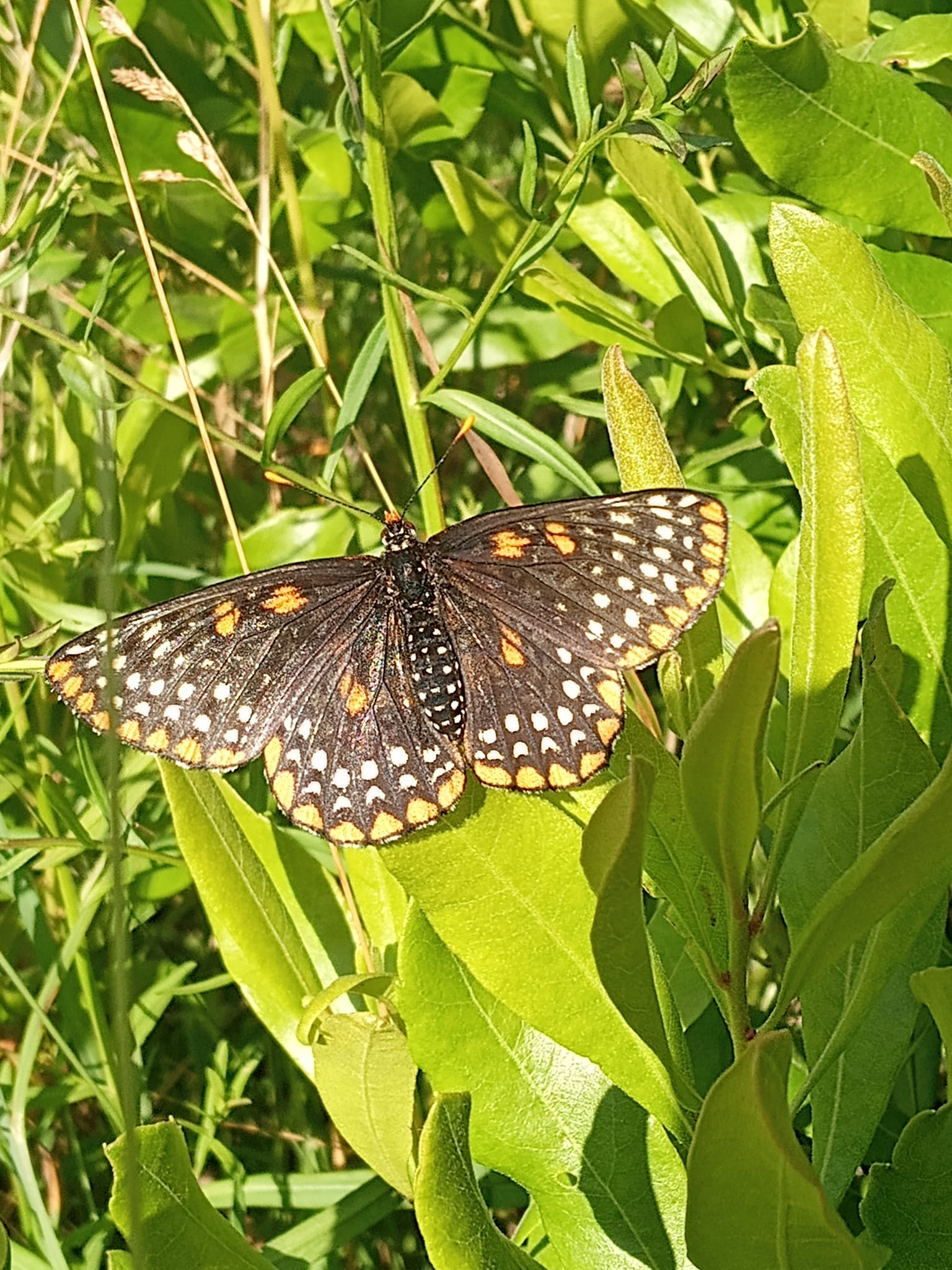
Two photos of
Baltimore Checkerspots


Butterflies

   Okay, now that I bored you with herps, let me bore you some more with butterflies. That's right, when I haven't been herping ( and even when I have) I've been looking for butterflies. I enjoy seeing butterflies and trying to ID them. As far as I know, the best place to see butterflies in RI is Francis Carter. A walk through the field will get you multiple species. I went there a couple of days ago and it was loaded with Eastern Wood Nymph, American Coppers, and I saw my first Monarch of the season. 

   Last month I "chased" a butterfly species. Yes, I have a sad life. Anyway, I drove to Crane Wildlife Management Area in Falmouth, MA and looked for Baltimore Checkerspots. This is a species I've wanted to see for a long time. When I was there in May, there were Checkerspot caterpillars everywhere. It was only a matter of time before they morphed. My friend Mike Tucker lives close by and he sent me a text that the butterflies were everywhere. That afternoon I took a ride down with my friend Laurie. It was awesome to see so many of such a beautiful butterfly. 

   Knowing myself, I can feel myself getting more interested in butterflies, so I invested in an adult butterfly net. It got delivered today. I can only imagine all of the ways it is going to change my life. 

   I have friends that catch dragonflies and damselflies. They are very good at IDing them. As of now, I still have so much to learn about herps and butterflies that I just don't have the time to try to add dragonflies as a hobby. However, if it something that interests you, there is another option to keep you busy over the summer. 

   I really do apologize for not writing this sooner. However, even though shorebirds will be here soon, the snakes and butterflies will still be around all summer. If you go out herping, you may fall in love with it like I did. If you are grossed out by snakes, maybe it isn't for you. But there are still plenty of species of butterflies to discover.

    As for the shorebirds, The day I went to Carter, Saturday, I also went to the mudflats behind the Breachway. There were very few birds. Maybe twenty peeps, ten Least Terns, and three Common Terns. I have friends that went to Napatree this morning and they said it was very slow. The shorebirds aren't really here yet, but they will be soon enough, until then, you can find me chasing snakes, frogs, and butterflies channeling my inner Tom Swayer.

More photos below

Lifer Fowler's Toad

Pickerel Frog from yesterday

Northern Water Snake 

The cutest thing I have ever seen...
A baby Diamondback Terrapin yawning
minutes after being born.


A Look back at May


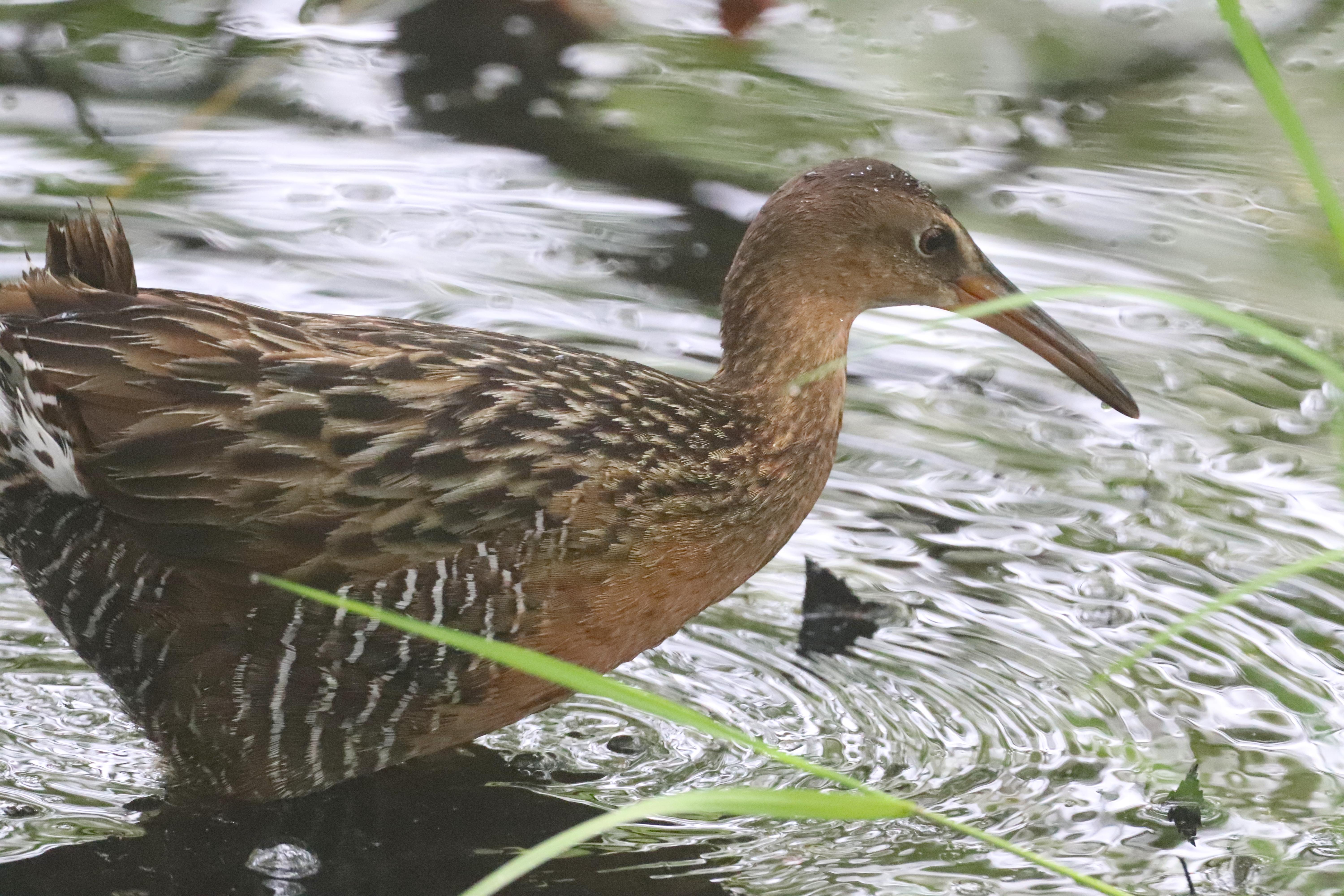
King Rail found by Sue Palmer

   May is undoubtably the best month of the year if you are a birder. Having colorful migrants fly through on their way to their breeding grounds is always amazing to me. This May had a lot of rare birds and I think it is fun to look back while the memories are fresh. In the below post I am trying to credit the finders as much as I can. Some of the birds I heard about I do not know who found them so please don't beat me up. Also, I'm sure a lot of "good warblers and flycatchers" were found and not reported, below are birds I know about. With that said here is a look back

   The beginning of the month was cold. Many of my birder friends said "things are a week ahead of schedule this year", but I did not see it. Many years I'll have Black and White Warblers, Redstarts, and Yellow Warblers in late April, but not this year. I didn't get those birds until a few days into May. We did have very persistent NW winds and until they turned to a southernly quadrant things were slow.

   The best bird found the first week of May was a Yellow Throated Warbler at Swan Point by Sue Talbot. The bird was there a couple of days and I did end up seeing it with the help of Dick and Marge Bradley as I only had a few minutes to be there. 

   May 5 Barbara Seith had a Least Bittern at Trustom.  The bird has been calling on and off most of the month along with a report at Mud Pond. Also on May 5 was the first report of the year of our lonely Chuck Will's Widow at Tillinghast by Melissa Alexander

   May 6 Barbara Sherman reported the first Blackburnian of the year at Trustom. A day later Paul L'Etoile had one in his yard. Louise Ruggeri had one in at Mia as I was standing right next to her but she saw it first. Incidentally the one at Mia was a life bird for Ian and Jen Krider. That day at Mia was pretty good. We also had Black Throated Blues and many warblers to look at.


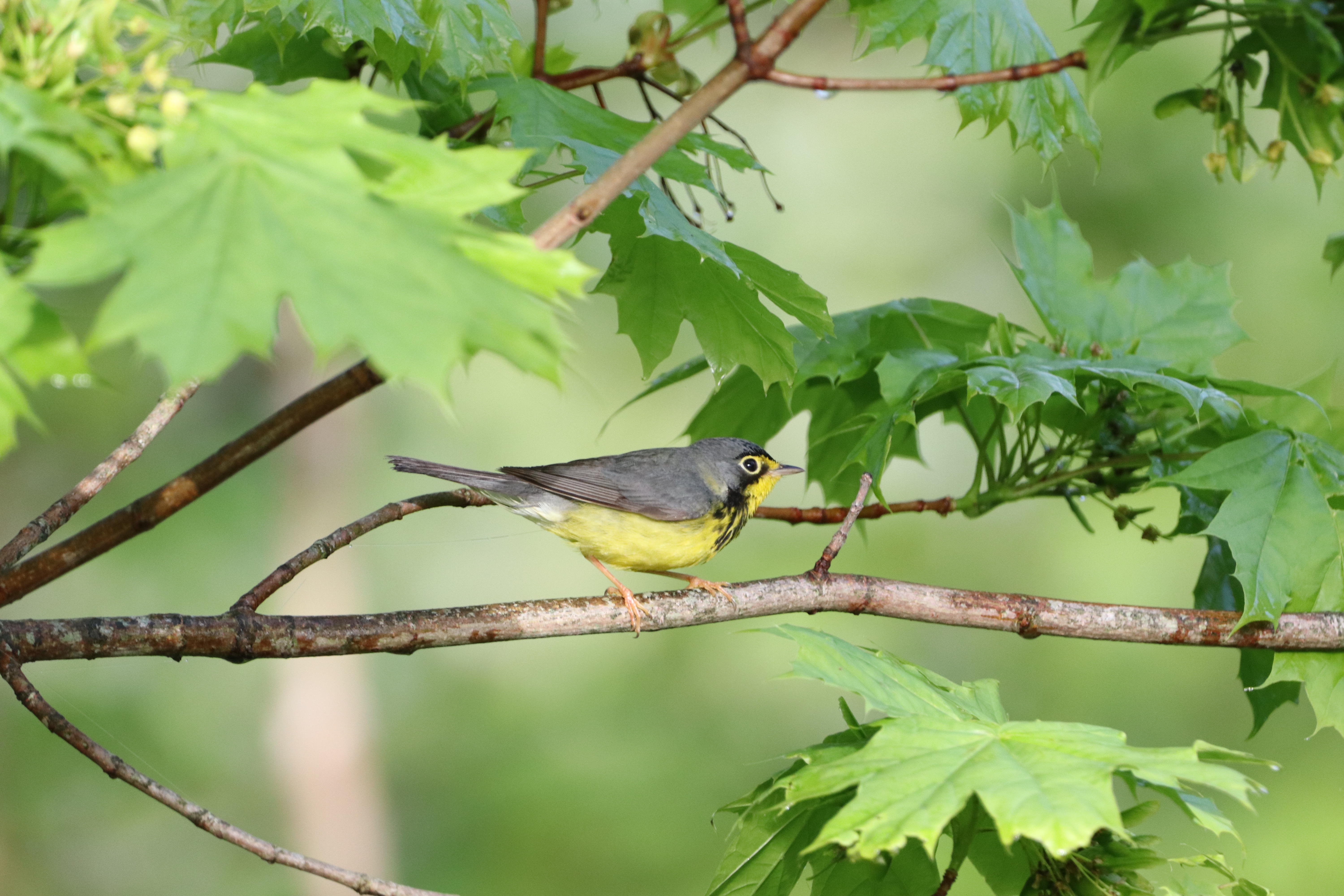
Canada Warbler found by Chris Veale

 Chris Veale found a Canada Warbler about this time, but I don't remember the exact date. I got to see it and got my best photo of a Canada to date thanks to his find.

   May 8 Drew Wheelan had a Boat Tailed Grackle on the Block

  There were three Kentucky Warblers found during May. Alan Kneidel had one at Swan Point, Steve Dziadosz had one in Foster. There was one found at Mia that was very accommodating for photos. 

   May 13 brought one of the craziest events ever in RI. Arctic Terns were everywhere over freshwater lakes and way up into the bay. Arctic Terns, which never visit RI were seen from Long Island Sound, up to the East Bay, Diamond Hill Reservoir, and into Mass at Quabbin and Wachusetts. Thanks to Peter Capobianco I saw them in Cumberland ( I was on my way home from two days at Plum Island).

   May 16 was probably the day to be at Mia or out birding in general. The Kentucky Warbler and a Cerulean, found by P Carl, were bathing together in a little pool.  Louise Ruggeri also found a Mourning Warbler that put on quite a show for photographers. 

Also on the 16th, Mississippi Kites were showing up everywhere. They were reported here and there throughout the month but the 16th they were in multiple places. 

 On back to back days Jess Bishop had great birds. On the 17th she found  a Mourning Warbler on Snuff Hill Rd. On the 18th she had a Prothonotary at the Bonnet Shores Community Center.

   May 20 Sue Talbot struck again with a Yellow Bellied Flycatcher at Swan Point. Also at Swan Point, Tim Metcalf found a  Lincoln's Sparrow.

    BJ Whitehouse had a White Faced Ibis at Ft. Getty.

May 21 Alan Kneidel crushed it again with a Cerulean on Ponagansett Rd.

Bird Club president Tom Younkin found a large flock of Red Knots at Napatree on May 22

Norther Fulmar

   On May 26 thirty two birders went out on a dedicated pelagic on a Francis Fleet Boat. The boat went out to Cox Ledge. One person saw a South Polar Skua ( Paul L'Etoile with photos), a few birders did see a Red Necked Phalarope. The highlight for most of us was a Northern Fulmar that put on quite a show behind the boat for thirty minutes. We also had Great Shearwaters, Sooty Shearwaters and Wilson's Storm Petrels in very good numbers. It was a perfect day to be on the water

May 28 Sue Palmer found a King Rail at Trustom Pond. Once found, this bird has been super cooperative staying right out in the open unphased by lurking birders and photographers for a couple days.

 The following day, Sue found a Cattle Egret in Matunack  hanging out with some Herefords.

Later in the month Francis Carter was the place to be Grasshopper Sparrows came back as did the Indigo Buntings, Prairie Warblers and Eastern Kingbirds. There have been two flyover Sandhill Cranes. Flyover Missisissippi Kites were seen and photographed by Tom Younkin There is a Dickcissel (found by Tim Metcalf) pair that has been seen mating. The Blue Grossbeaks have been seen but not regularly. Jess Bishop and Bill Thompson have recordings of an Alder Flycatcher from over the weekend.  

  For me personally, I saw many but not all of these birds. I was working through the Kentucky, Cerulean, and Mourning Warblers that were posing like runway models at Mia. I did hear the Cerulean on Ponagansett Rd, but was hoping for a photo. I did get photos of the King Rail which was probably my RI highlight besides the pelagic. My best bird that I found by myself was a Solitary Sandpiper that stuck around the Cumberland Monastery for a couple of days. 

Up north I went to Plum Island three days. I went Thursday and Friday May 13, 14. Thursday was tough and I had to work for every bird. Friday brought in a few more birds. I saw a Nashville, Blackpoll, and the common species. 

Blackburnian at Plum Island
   The following week was spectacular at Parker River. I was told that Monday (the 16th which was the best day of the month in RI also) was the best birding day on the island in fifty years.  The winds were just right to drop thousands of migrating birds out of the sky. I looked at some ebird reports and they were insane. One report had 102 species while another had 18 Blackburnians! The whole week was supposedly very good.

  I went Friday the 20th. I can't imagine the Monday being any better. Birding was so good at Plum I birded for eleven straight hours. My tally is absolutely ridiculous. 


18 species of warbler, 3 Blackburnians, 3 Northern Waterthrushes, 8 Wilson's, 6 Canadas, 15+ Bay Breasted, 10+ Chestnut Sided, Over 25 each Black and Whites, Mags, Black Throated Blue and Black Throated Greens. Over 100 Redstarts and Common Yellowthroats. One Scarlet Tanager and a pair of Cape Mays, and a Lincoln Sparrow. It was one of the best birding days of my life. I got six photo upgrades and one life photo (Wilson's Warbler). 


This amazing bird is a Kirtland's Warbler
Seen by the RI Audubon group at Magee Marsh, OH.
Photo credit goes to Dian Kriz
   Out of New England, a group of RI Audubon birders took a trip to Magee Marsh in Ohio and they saw a Kirkland's Warbler among other things!  Among those other things were Trumpeter Swans, Black Necked Stilt, Bald Eagles, Sandhill Cranes, Whip-poor-will, a Red Bat, not to mention all of the warblers!

   All in all May birding was very good in RI this year. There weren't two many days where birds were dripping from the trees, but almost all of the rare warblers showed up. In my opinion, it took a while to get going but from the middle of the month on there was usually something I wanted to see. Here's to hoping some June rarities show up!


Wilson's Warbler,
Plum Island,
May 20, 2022
Life Photo